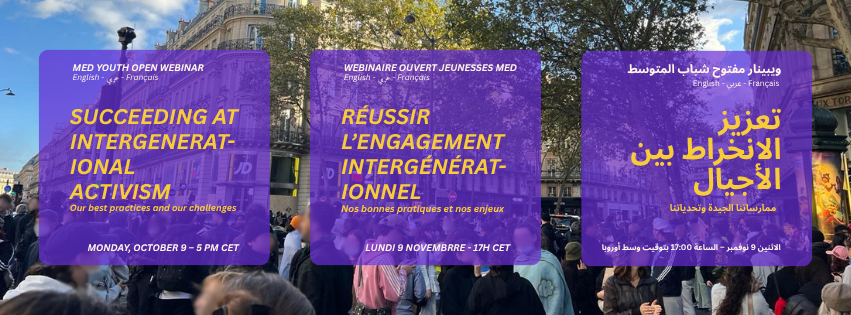
Discussions: Making Intergenerational Engagement a Success

Making Intergenerational Engagement a Success: Our Best Practices and Challenges
A Look Back at Our Open Webinar on November 9, 2026

A Discussion on Intergenerational Relations

In our associations, our organizations, within decision-making bodies, and in civic movements, we—the youth—are involved in many different ways. But how can we ensure that our participation leads to real impact and fosters unity without being exploited? 
 
How can we make our voices heard, gain recognition for our commitments, and influence decisions? How can we build alliances across generations when our practices and communication styles differ? 
 
We gathered to discuss these issues alongside our two guests: Soufiane Hennani, a Moroccan podcaster, and Mina Magdy, an Egyptian youth worker. Thank you to Chaden Moataz, a long-standing member of the Jeunesses Med governing body, for moderating the discussion. 

Definition of Intergenerational Relations

Intergenerational relations refer to the interaction and collaboration between different generations—in society, in the workplace, in our struggles and activist practices, and within decision-making bodies…
 
Intergenerational collaboration can be difficult—or even counterproductive—when our communication styles and activist practices differ, to the detriment of young people’s voices and ideas. 
 
Thus, addressing intergenerational relationships is a key first step toward transcending traditional power dynamics and creating a genuine space for mutual enrichment, where everyone’s experience and perspective are valued. The challenge is to ensure that no one is reduced to their age. 
 
Here are our suggestions for best practices that young people can follow to foster successful dialogue. 

1. Adopt a listening mindset so we can adapt more effectively 👂

Listening helps us understand the perspectives of other generations—their histories of activism, their constraints, and their norms—so we can figure out how to get our ideas across. Adapting to different modes of communication empowers us to be heard without giving up what we stand for, without remaining silent, and without fading into the background. 

2. Stay true to who we are and live by our convictions 🪞

Our legitimacy comes from our lived experiences and the way we engage. Living out our convictions means putting them into practice in our struggles and in our daily lives, not just in the demands we make. Adapting our communications without conforming.
"Gen Z has taught me that freedom must be lived—of course, we must demand it, but above all, we must live it" — Soufiane Hennani

3. Let’s come together to be stronger as a group 🪢

We can appear stronger by speaking with a collective voice, provided that this voice reflects our diversity. To achieve this, we can create preliminary spaces that are segregated by generation—when the context allows—promote diversity and pluralism within our spaces, and lead by example to show that differences are strengths. 

4. Set clear guidelines from the start ⚖️

Establish a clear and explicit framework that protects everyone during interactions, but also safeguards against exploitation. This can be achieved through awareness-raising sessions on generational power dynamics, a charter of trust and non-discrimination, and a clarification of each person’s roles, responsibilities, and decision-making authority. 

Contact us

Do not rotate